
What Is Truth, Really?
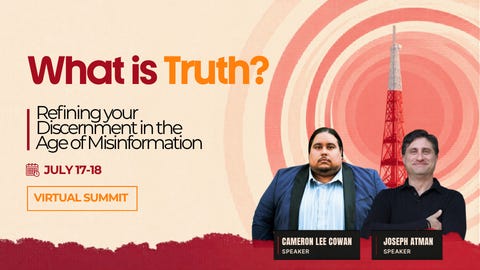
Joe Atman gives us a preview of his talk at the What is Truth? Summit this weekend. Come join fellow truth seekers!


I have spent a great deal of time thinking about truth, and in many ways, the large majority of my philosophical work has been an attempt to ascertain what reality actually is. And of course, that more or less implies trying to understand what truth is.
But I think before we ask what truth is, it may be worth asking why seeking truth matters at all.
Why bother?
Because truth is not just an abstract concern. It is not merely a philosophical luxury, or a matter for academics, theologians, or people predisposed to speculation. Truth is imperative. It is imperative to our survival, not only consciously, but as biological creatures trying to live with one another in a real world. Without truth, we lose our footing. Without truth, we do not know ourselves. Without truth, we do not meaningfully know one another, or the world, or our relationship to it.
We may still have opinions. We may still have beliefs. We may still have systems and narratives and identities. But those things are not the same as contact.
And I think that distinction is one of the most important of all.
The Difference Between Contact and Belief
One of my core convictions is that human beings are, in a very profound sense, innocent creatures. I know that can sound naive. But I do not mean innocent in the sense that we are never harmful, never confused, never manipulative, never destructive. I mean that we are generally good-natured, well-intended people who are seeking out the best not only for ourselves, but for the world.
And it is precisely because of that innocence that we become vulnerable to falsehood.
We want to understand. We want orientation. We want a way to make sense of things. So when there is a void in our understanding, belief steps in to fill it. A belief gives us a bridge across uncertainty. It helps complete the puzzle of the world, even if only temporarily.
That is why belief is so powerful. It is not simply that people are foolish, stubborn, or irrational. It is that we are hopeful. We are ready to believe because we are trying, sincerely, to comprehend what actually is.
But belief and truth are not the same thing.
A belief is often something I put into place so that I can carry on with a certain kind of understanding. Truth is what is there whether or not I understand it.
That is where the trouble begins.
Because once I have a belief, I often stop seeking truth and begin seeking reinforcement. I need the narrative to remain intact. I need the system to keep holding. I need the explanation to continue making sense of my life. And if that belief does not have a proper foundation in reality, then I can become deeply attached to something false, not because I am especially wicked, but because I am sincerely trying to find my way.
Truth Is Not Something We Necessarily Create
One of the things I return to again and again is the idea that truth is not something we create, per se. It is not our job to invent reality. It is not our task to overlay some preferred interpretation onto the world and call it truth.
Truth is already there.
Reality is already there.
What is, is.
So, our task is not so much to pick up reality as if it were absent, but to put down those things that have disabled my ability to connect with it fluidly.
That means concepts. Ideologies. Inherited narratives. Prefabricated identities. Belief systems I have mistaken for reality itself.
I think this is one of the great human difficulties. The world gives us all manner of conceptual tools, and they do have utility. But they are only tools. The problem begins when we do not put them down, when we no longer use them but are used by them.
Then a concept becomes a cage.
An ideology becomes a substitute for perception.
A narrative becomes more important than the world it was supposed to describe.
And before long, we are no longer in contact with reality. We are in contact with our ideas about it.
The Word Is Not the Thing
This is also why language matters so much.
The word is not the thing. The concept is not the reality. Description, comprehension, and reality are not the same.
Language can be a beautiful and necessary tool. It can help us point, share, communicate, invite, and illuminate. But language can also turn against us when we begin to mistake naming for knowing.We become very good at talking about things and much less capable of actually encountering them.
We live in a time overflowing with explanation, and yet often so lacking in understanding. We have no shortage of terms, frameworks, labels, diagnoses, and arguments. But the presence of language does not guarantee the presence of truth. In fact, sometimes the opposite is the case. Sometimes language further conceptualizes things and distances us from direct relation.
If language is to be useful, it has to remain turned toward reality rather than toward endless self-perpetuation.
Language should access reality, not further conceptualization.
That is a difficult task, because we need language to talk about what is beyond language. Still, I think it can be done, but only if we use our words with a great deal of caution, humility, and honesty.
Why the Same Problems Keep Returning
I have often asked why it is that new leaders emerge, new policies are introduced, new eras declare themselves, and yet somehow we keep arriving at the same human problems in different clothes.
I think the answer is that the surface manifestations change, but the deeper issue remains.
That issue is conception itself.
It is our captivity to ideas.
It is our attachment to systems, beliefs, identities, and frameworks that have ceased to function as tools and have instead become total environments. We no longer realize we are interpreting reality through them. We think we are simply seeing.
And so we keep butting up against the same problems because we have not gone deeply enough. We have tinkered with the machine without addressing the force that drives it. We have replaced one arrangement with another while leaving the same conceptual captivity intact.
This is why truth requires more than better argumentation. It requires a transformed relation to thought itself.
Reinforcing Truth Rather Than Fighting Falsehood
One of the most important practical conclusions I have come to is that our task is not merely to attack what is false. In many cases, our task is to reinforce what is true.
That may sound passive, but I do not mean it passively.
I mean that truth has a kind of gravity to it because it is real. Falsehood often needs constant support. It needs repetition. It needs defenders. It needs conceptual allies. It needs fear, pressure, and reinforcement in order to keep going.
Truth stands on its own.
That does not mean falsehood cannot dominate for a time. Clearly it can. But it cannot do so independently. It must be underwritten. It must be maintained. Reality needs no such maintenance.
So instead of orienting my whole life around direct opposition, I think there are many times when the wiser path is to reinforce the reality I want to see made more obvious. Instead of merely sabotaging the tree cutters, plant more trees. Bring forth what is aligned with reality. Live it. Build it. Strengthen it.
In terms of truth, that means my job is not only to denounce unreality, but to become more honest, more perceptive, more grounded in what is actual.
Discernment Begins With Honesty
All of this sounds lofty until it becomes personal.
Then it becomes difficult.
Because discerning truth does not begin with fixing the world out there. It begins with asking what in me is inherited, what in me is defensive, what in me is afraid, what in me has become so attached to explanation that I can no longer see clearly.
Can I observe something without immediately naming it?
Can I encounter something without forcing it into a prefabricated understanding?
Can I notice my biases, my preferences, my reflexes, my stories, and ask where they came from?
Can I understand what it is that makes me react the way I do?
That kind of honesty is demanding. But it is also one of the few real pathways into truth. When we are talking about discerning truth, we are really talking about discovering ourselves. We are talking about discovering what we actually are, and what in us has merely been layered on.
Is Happiness the Goal?
I have said elsewhere that I am not convinced happiness is life’s highest goal, at least not in the way we usually mean it.
Of course we all want to be happy. Of course we want peace, relief, joy, contentment. But I think something more primary is the discernment of reality itself.
To understand what is.
To come into some right relation with what is actual.
And from that, perhaps happiness follows. Or if not happiness in some constant emotional sense, then at least a deeper kind of footing. A clarity. A steadiness. A way of being that does not depend entirely on illusion.
If I can see clearly, then even difficulty can be borne differently. Hardship does not disappear, but it becomes part of a larger reality that can still be lived through, learned from, and integrated. Everything has the potential, eventually, to find its balance.
Becoming More Truthful
Truth can be questioned. In fact, what is real welcomes questioning because there is something there to be discovered. Falsehood is different. It often resists examination because there is nothing behind it but more support beams.
That is one of the great signs.
Truth opens.
Truth unfolds.
Truth can be lived with.
Truth does not need me to invent it, only to recognize it.
And maybe that is the work. Not to become a person with the most impressive conceptual system, but to become a person increasingly capable of contact. Increasingly capable of seeing. Increasingly capable of being honest enough, quiet enough, and brave enough to meet what is.
I think human beings are carriers of truth in that sense. Not because we possess it perfectly, but because we are capable of participating in it. Capable of recognizing it. Capable of reinforcing it through the way we live.
So perhaps the task is not simply to speak about truth.
Perhaps the task is to become more truthful.
And I suspect that if we can do that, even imperfectly, then we will have done something far more meaningful than winning an argument.
We will have come a little closer to reality.
Join Joe, Cameron, and all our friends as we seek the truth and refine our discernment in the age of misinformation. It’s this weekend, July 17-18.
Sign up now (it’s free thanks to the Royal Falcon Foundation!)

 | A guest post by
|